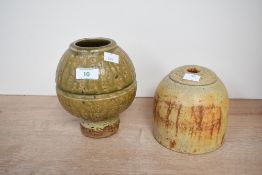
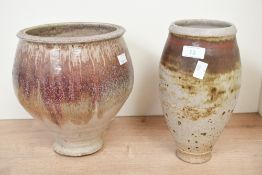
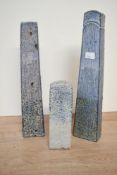
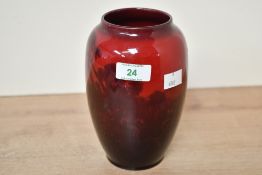
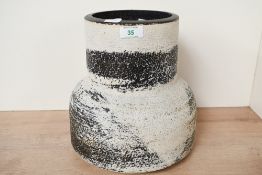
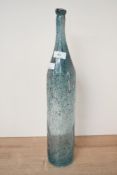
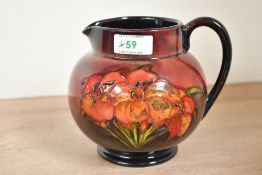
Two late 20th-century Patrick Reed (1943-2017) studio pottery vases, featuring amorphous ovoid pod-like forms that taper to a narrow foot, with deep maroon and tertiary glazes, impressed marks to bases, (2), condition consistent with age and use. Patrick 'Pat' Reed (1942-2020) was a distinguished British ceramic artist, master potter and educator whose work developed from the progressive studio pottery movement of the 1960s. He studied at York School of Art from 1960-1964 before attending the Royal College of Art, London (1964-1967), where he was awarded a First-Class Honours degree in Ceramics. At the RCA, Reed came under the influence of leading figures including Hans Coper, who taught him two days a week, and Eduardo Paolozzi. In 1966, a scholarship took him to Scandinavia, where he met the Swedish designer and ceramicist Stig Lindberg and completed a placement at the Gustavsberg porcelain factory, an experience which had a lasting influence on his approach to making and production. Following his studies, Reed established a substantial body of ceramic work, exhibiting in the UK and USA and selling extensively. His practice included the distinctive 'family groups' of pots for which he worked continuously for extended periods, developing relationships between individual forms within a group. His work was exhibited by the Crafts Council of Great Britain and included in a Royal College of Art travelling exhibition to New York, Chicago and Seattle. Alongside his studio practice, Reed enjoyed a long and highly respected career in art education. He was Head of 3D Design at Rochdale School of Art for thirteen years before returning to York, where he became Curriculum Manager for 3D Design and Crafts at York College. He was greatly admired by generations of students and colleagues, and retired in 1998. The present works were included in a posthumous exhibition celebrating Reed's practice and represent an opportunity to acquire ceramics by an accomplished Northern British maker whose work has been relatively little represented in the auction market. This is the first time Patrick Reed's work has been offered at auction.